Flying fish
Life of PiFlying fish are both a recurring food source and a turning point in Pi Patel’s life at sea. Their arrival first gives him a chance to redirect Richard Parker’s attention, then forces him to kill for the first time, and later helps bring him a substantial catch. In these encounters, a creature that escapes the water becomes central to Pi’s changing relationship with survival: it offers sustenance, but not without cost.
Appearance and First Encounter
The first flying fish Pi encounters aboard the lifeboat is about fifteen inches long, slim, dark grey-blue, with featherless wings and yellowish eyes. It has struck him across the face while Richard Parker remains some distance away. Pi discovers the fish in the locker, where it is flapping, and recognizes that the tiger has noticed it too. With Richard Parker showing interest, Pi sees an opportunity: as he had hoped a rat might do, he can use food to encourage the tiger to approach and accept a reward.
That plan fails almost as soon as it begins. Pi throws the fish toward Richard Parker, but it spreads its wings and changes direction just before reaching the tiger’s open mouth, dropping into the sea. Richard Parker snaps at it, misses, and turns back toward Pi. The failed offering leaves Pi afraid that the tiger may approach him instead, and he considers whether he can reach the raft before Richard Parker reaches him. The fish is therefore not merely food: at this moment it is also an improvised training tool, and its escape leaves Pi exposed to the danger he meant to manage.
The Swarm and the Pursuit
The danger changes when a school of flying fish bursts from the water. Dozens leap at once, some crossing a great distance through the air; fish strike the lifeboat, pass over it, or land inside. Pi is caught in the open and tries both to shield himself with a blanket and to catch the falling fish. The sudden abundance is physically hazardous, but it also makes available what his first attempted offering had failed to provide: more food than a single fish could supply.
The reason for the swarm soon becomes clear. Dorado are chasing the flying fish from below. The larger fish cannot fly, but they swim faster and lunge after prey near the surface. This pursuit makes the flying fish part of a larger chain of survival: their escape from the water brings them within reach of Pi, while their pursuers may become food themselves. Later, during another storm of flying fish, Richard Parker actively swats at them as Pi shelters behind a turtle shell and tries to catch fish with a gaff and a piece of net. The recurring spectacle is never simply a spectacle; each burst of movement presents an uncertain opportunity to eat.
Killing and Learning to Fish
After the swarm, Pi gathers fish from the locker and the lifeboat. He wraps one in a blanket, takes the hatchet, and proceeds carefully, remembering that the loss of his tackle earlier has made him wary of another mistake. The fish struggles, and Pi hesitates repeatedly before finally killing it. He weeps over what he has done: at sixteen, previously harmless and religious, he regards himself as a killer and feels the burden of taking a sentient life. He says in retrospect that he never forgets to include the fish in his prayers. The act makes survival concrete in a way that planning alone could not; he must take a life to sustain his own.
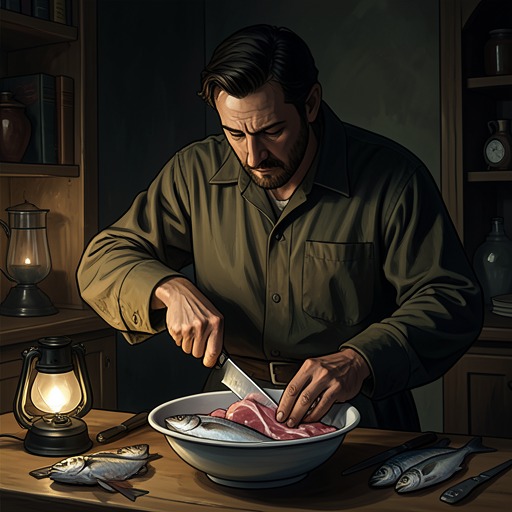
Once the fish is dead, Pi finds it easier to see it as food, resembling fish sold in the markets of Pondicherry. He cuts it into pieces and puts them in a bucket. That evening he tries fishing again. Small fish nibble at the hook but are too small to catch, so Pi casts farther out and lets the line sink beyond the fish gathered near the raft and lifeboat. He then uses the flying fish’s head as bait, casting and retrieving it near the surface. This produces his first strike: a Dorado lunges at the bait. The flying fish has thus helped Pi move from gathering whatever falls within reach to experimenting with where and how to fish.
Food, Risk, and Confidence
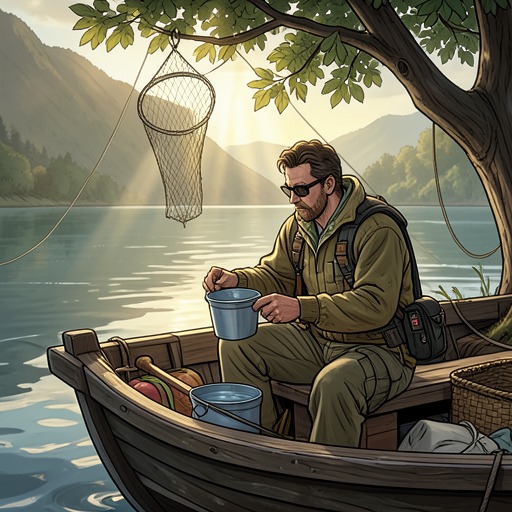
A later encounter shows how much can turn on a single flying fish. On a cloudy morning, while another storm of them crosses the lifeboat, Pi extends a gaff with net attached in the hope of catching one. A Dorado pursuing a fish leaps from the water, misses its target, and strikes the boat. Pi retrieves it before a shark can reach it. The fish is large, roughly forty pounds, and would provide food for many meals. Pi gives thanks to Jesus Christ, but the catch immediately renews the danger: Richard Parker turns his attention from the airborne fish to the fish in Pi’s hands and crouches to attack.
Pi holds Richard Parker’s gaze rather than retreating. The tiger eventually turns away, and Pi carries the Dorado to the raft. Soon afterward he gives Richard Parker a substantial share. The episode changes Pi’s sense of their arrangement: from that day he feels more confident in his mastery and begins spending progressively more time on the lifeboat, first at its bow and then on the tarpaulin. The flying fish themselves are not a lasting solution to the danger between them, but their repeated arrival supplies food and occasions on which Pi must act decisively. Their role in the story gathers several forms of survival into one: evasion in the sea, opportunity on the boat, the moral difficulty of killing, and the confidence that comes from learning to live alongside a predator.